One of the wonderful requirements of my scholarship is taking language classes in the local language. In Bengaluru, this means Kannada. Kannada is one of roughly 70~ Dravidian languages, a family of languages spoken by around 250~ million people, primarily in South Asia. If you’ve watched RRR, or more my speed, Mindy Kaling’s Never Have I Ever, you’ve been exposed to two other major Dravidian languages, Telugu and Tamil, respectively. Rounding out this list with Malayalam, these four Dravidian languages are the main ones spoken in South India. Kannada is primarily spoken in the state of Karnataka, and there are about 55 million speakers worldwide.
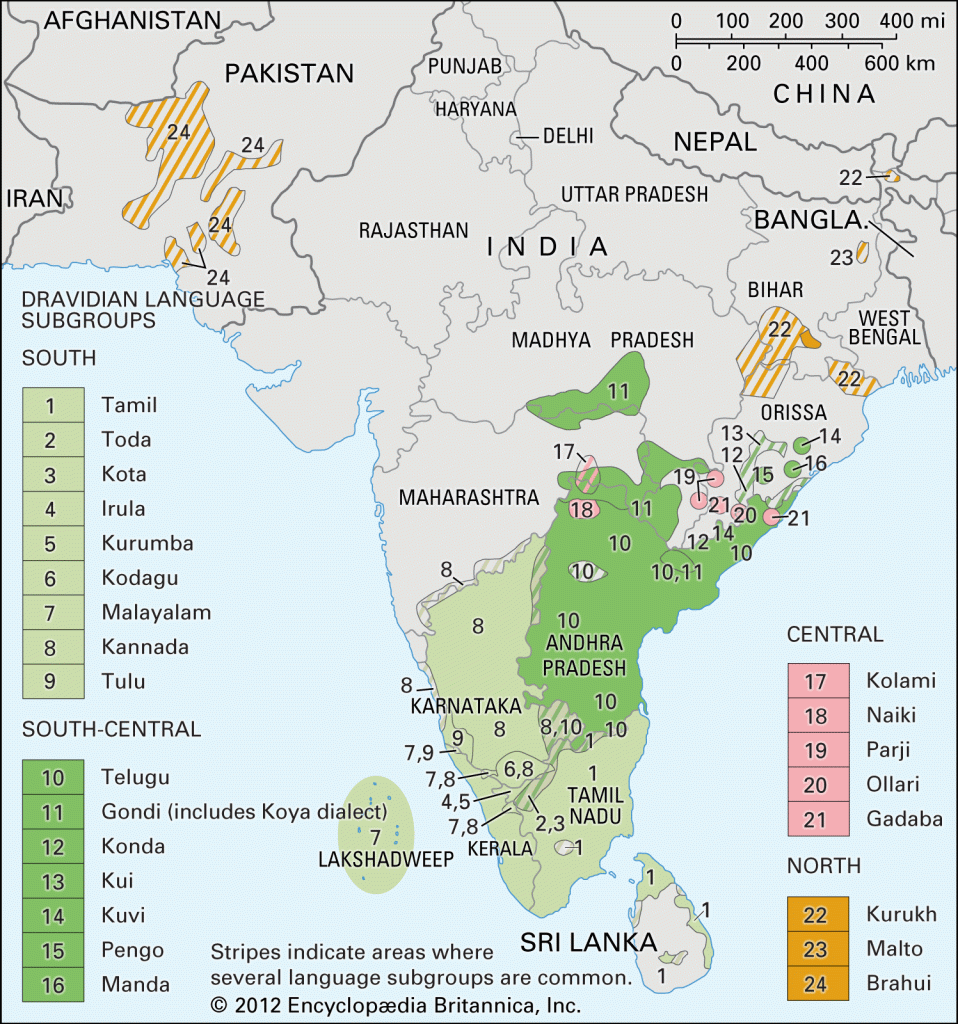
I’ve sort of alluded to it in previous posts, but Bengaluru is one of the most linguistically diverse places I have ever been. It’s incredibly common for people to speak 5+ languages; typically, this would include multiple South Indian languages, Hindi, and English, but this varies from person to person. From neighborhood to neighborhood, the dominant language can vary as well, and in “posh” areas, there is a major lean toward English. With this linguistic diversity, there are also unique challenges and tensions. Kannada (I can attest) is not the easiest language to learn, and depending on where in town you live, it may be more or less useful. This combined with an unimaginable influx of new residents in this city of 14 million, and many residents coming from North India, where Hindi is more of a lingua franca, and there is a growing push and tension that migrants to the city should learn Kannada. Early on, when I arrived, auto-rickshaw drivers even started a campaign to teach passengers basic words. I was gifted one of these signs for my early attempts at using Kannada. While this debate is nuanced and hits on lots of tensions in the country, my general vote is that learning a few basic expressions is a good idea for anyone living here.

In this linguistic context, I’m taking Kannada (and Hindi) classes at a local language school called the NILE Institute of Languages and Education. Before arrival, I knew no Kannada, and I was able to have a basic conversation in Hindi and read Hindi characters. Still, I think everyone at the school (self-included) was nervous about how I would do without having any Indian language as a native language. For context, Kannada has around 50 characters, and to my ears, the language sounds really lovely, with lots of vowel sounds. For example, “Did you have dinner?” is pronounced like “oota aita?” and the plural of “towns” is “uurugalu.” For folks who speak Hindi, Kannada has a few extra sounds, like an extra “o” variant, and a few different consonant sounds. Here is a two-minute YouTube video with intros to get a sense of the language!

Taking me from zero Kannada to conversational and greatly improving my Hindi has been a considerable feat, thanks to my two teachers, Kavitha and Sonya. I’d also be remiss if I did not mention the founder of NILE, Suresh Sir, who founded the institute after a 20+ year career in the Indian Navy and has created such a fun environment for me to learn languages and work around my scholarship schedule. My initial classes were all private, and Kavitha Ma’am taught me the basic alphabet and sounds of Kannada. For fellow English speakers, Kannada pronunciation requires tongue and throat motions that we have never encountered. My general philosophy as a language student is that all that matters is being understood. Still, pronunciation is a consistent struggle in every language I’ve learned, and Kannada was no exception. Other new language features include what Kavitha calls “baby letters,” where one letter modifies another to make a new sound (e.g., d+d = dd). Learning characters is also incredibly humbling and brings you directly back to first grade. I developed quirky memory tricks, like “swan with nice hair” and “snake” to remember the characters (see if you can find them in the photo).

[skip unless you love language learning]
Apparently, I am needing out on the Kannada language more than I expected, a few other things I think are cool/different:
- There isn’t a super standard way of writing Kannada in Latin characters; you just sort of use your heart.
- When conjugating verbs, there are a zillion forms based on gender, human/object, and age. But in the negative, like “it does not do,” everything gets the same treatment.
- “I” and “We” are conjugated very similarly; when learning how to conjugate verbs, you start with “I” and then “We” before anything else.
- When introducing your thought or opinion, you say the thought first and add the qualifier “I think” at the end of the sentence.
- There are lots of reflexive verbs for things that don’t have them in English. For example (roughly translated), “to me know” and “to me tiredness happens” are phrases.
- Words have a ton of syllables. I speak is “nanu martanaduttini.”
[resume]

The best thing about learning a language is that it opens you to new experiences and ideas. Attending a local language school and being the only international student has exposed me to so many parts of culture, from regional holidays to learning about how classroom environments work in India. In general, I think there is slightly more respect for teachers here than in an American context. That said, Kavitha and Sonya constantly joke with me to help make class fun. Some favorites include Kavitha ma’am encouraging me to wear less boring clothes because I look much better in traditional Indian attire and my general failure to eat a suitable breakfast. This connection provides a little sense of home and family when I am so far away from mine. As an extra bonus, NILE hosts many events, providing even more chances to meet fellow students. We went on a day trip and lounged at a resort and recently, the school celebrated its 15th anniversary with a big party. Every NILE event is full of students showing off their singing, dancing, and other talents, usually followed by delicious food. Check out this fashion show of students slaying in attire from their regions from the 15th anniversary.
I still have a long way to go in six months of learning. Right now I benefit greatly from using Kannada + English and Hindi + English (Kinglish and Hinglish) to get by in Bengaluru. That said, every time I successfully tell a cab driver where I’m going or meet someone at my research site who is genuinely thankful that I’m taking the time to learn, I’m reminded this is a rewarding journey and thankful for my language learning family ❤


Leave a comment