Proposed subtitle #1: Local woman discovers that late-stage capitalism makes city planning even more challenging
Or, perhaps more constructively, proposed subtitle #2: A call for planning theory to help us deal with the messiness of actually practicing planning.
In the spirit of maintaining my four-posts-per-year cadence, this blog aims to address the tensions of transitioning from planning school to working as a planner (in my case as a community planner in the social impact sector). One of these big tensions, and one that I’m begrudgingly encountering in my planning certification test prep, is the need to spend a lot of time on rote memorization of major planning theories. As a “doer,” it’s pretty easy to fall into the trap of asking, “Why does this planning theory even matter?”
For friends in city planning, architecture, and probably any social science discipline, graduate programs often make a distinction between theory and practice. “Theory” is more conceptual, asking questions like “what is the purpose of a planner,” “who should benefit from planning solutions,” and “what power structures do our plans operate within.” “Practice” is actually making a plan, e.g., implementing a new zoning code, placing a new regulation on water use, etc. Professors will emphasize that they are not practicing planners—academics are guided by a separate, though not totally disconnected, goal to teach and produce research that advances the planning discipline. I think the best professors skillfully position themselves to support communities with the “theory” and research rigor needed to improve planning outcomes, while still connecting back to the discipline as a whole. The best practitioners, similarly, should be able to fall back on theory when they encounter complex ethical questions that arise in planning.
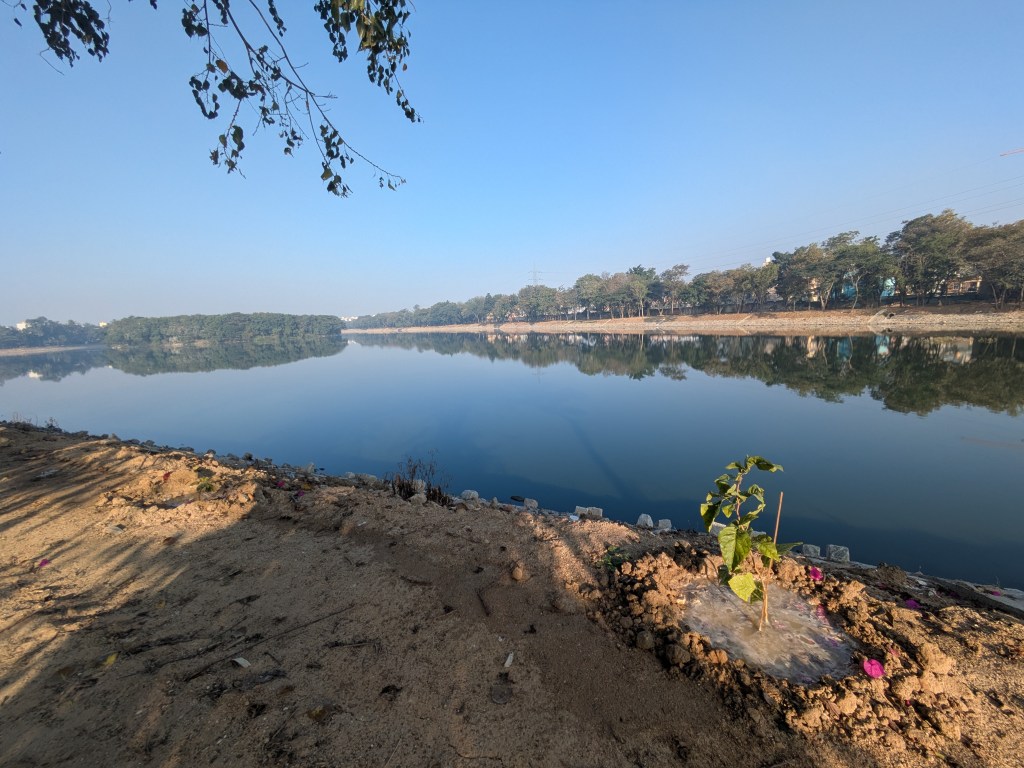
Supporting communities with planning research and theory was my aim when I conducted fieldwork in Bengaluru with two community lake groups for my thesis. The Benniganahalli Kere Trust and Kasturinagar Welfare Association (KWA) advocated for restoring local lakes that had been neglected for decades. Benniganahalli Lake caught fire in 2017 due to pollution inflows, and B. Channasandra Lake (located in Kasturinagar) was forgotten to the point of being erased from city maps. During fieldwork, community members would say I was a “lake expert”; all I could think was, “no, y’all are the ones actually doing this work…” My bias towards practice over theory strikes again. Moreover, the hundreds of hours of advocacy, organizing, and physical labor these groups undertook to restore their lakes dwarf the short amount of time I spent researching. Knowing my contribution was time-sensitive, I aimed to document the systems that harm lake health in hopes of making restoration easier for these communities. One of my biggest (unexpected) contributions was discovering a very old map that demarcated Benniganahalli Lake’s historical boundaries. The community then used this map to advocate for a larger scope of restoration.
Coming back to the idea of applying theory, I’ll connect back to some core topics on the American Institute of Certified Planners (AICP) exam. Per the AICP, planning professionals should aspire to serve the public interest. Applying theory, we might ask 1. What is the “public interest?” 2. Is there a way to truly protect the public interest when land, water, and homes are tied to an economic value?
For the latter question, I hope so, with the caveat that protecting the public interest under capitalist systems may not always be the most efficient option. Overturning power structures is rarely efficient; it requires relationship-building, repairing broken trust, and giving communities a chance to participate in decisions that affect them. These things can take a long time and can be hard to measure. And in this seemingly post-inclusion/DEI moment in the United States, where we have to dodge words like “equity” and “climate change” that could go against political forces, we simultaneously have to justify most planning actions with a measurable outcome. In my work as an environmental planner, this could look like quantifying the percentage of underserved community members expected to use a park. The intent behind measuring park utilization is coming from the right place, but predictive metrics without sustained monitoring probably won’t change outcomes, and forecasting who will benefit from a project is not the same as addressing underlying barriers to park access. What’s measurable and what’s important aren’t always the same.
Thinking critically about barriers to access and the ambiguous definition of “underserved” brings us back to part one of the question…what is the “public interest”?
If you’ve watched the Parks and Rec premiere, you’ve seen a fictional public forum where people are “caring loudly” (shouting) their different opinions. At the lakes where I worked in Bengaluru, the organized group of lake volunteers had differing and somewhat heated internal opinions on whether dogs could come to the lake. Further unpacking the definition of public, women had different access patterns at these lakes and rarely came by themselves in the evening. Even more complicated was the relative exclusion of workers in neighboring industrial areas, who had almost no interaction with these green spaces and would sometimes dump trash over the lake’s fence. All these communities are part of the public but have different needs, levels of access, and expectations for public spaces. Defining who is the “public” and how to prioritize and advocate for their needs is exactly where theory should come in to guide more ethical planning outcomes.
At its best, theory would stop us and make us reflect on who truly benefits from a proposed intervention (like a park), and it can challenge harmful underlying assumptions through a slightly more objective lens. Theory can challenge planners to define the level of community engagement in a particular planning process. We could ask: Are residents guiding this decision, or is their “participation” simply checking a box? Ideally, theory could also help justify longer timelines, deeper engagement, and extensive background research before beginning projects.
While no planning practice is neutral, my hope is that theory and research can help inform practice and minimize injustice and inequity in the planning process. I don’t really have answers on how (or if) theory should scale when planners are busy with deadlines, competing priorities, and all the challenges of this fascinating profession, but maybe that isn’t the point. In fact, I think theorists would say this is explicitly not the point.
There is a lot more to unpack, but in the meantime, I’ll learn more about these nuances through my work and through the fun journey of reviewing planning theory to prepare for my AICP exam.
Until then,
Vickie
P.S. When drafting this, one of my friends shared an article that social scientists make up a large portion of global leaders. Maybe there are some merits to a theory-backed education.

Leave a comment